You can call API methods from this subsection to manage different types of promotions.
- Get list of reward chains
Get list of value points
Create value point
Get value point
Update value point
Delete value points
Get list of items with value points
Set value points for items
Partially update value points for items
Delete value points from items
Create reward chain
Get reward chain
Update reward chain
Delete reward chain
Toggle reward chain
Reset reward chain
Get list of reward chains
LiveOps API (2.0.0)
- Version: 2.0.0
- Servers:
https://store.xsolla.com/api - Contact Us by Email
- Contact URL: https://xsolla.com/
- Required TLS version: 1.2
LiveOps is a toolkit for driving ongoing player engagement through promotions and personalized offers.
Use the API to manage the following features:
- Promotions — create and manage coupons, promo codes, discounts, and bonus campaigns.
- Personalization — specify the conditions for displaying the item catalog and applying promotions only for certain authorized users.
- Promotion limits — set a limit on how many times a promotion can be used by a user and configure scheduled resets for these limits.
- Reward chains & Value points — configure reward progressions tied to value point accumulation.
- Daily chains — set up recurring daily rewards to motivate regular logins.
- Offer chains — build sequential purchase offers with per-step pricing and free reward options.
- Upsell — a sales method in which the user is offered to buy an item with additional value.
The API is divided into the following groups:
Admin — calls for creating, updating, activating, and deleting campaigns and chain configurations. Authenticated via basic access authentication with your merchant or project credentials.Client — calls for retrieving available promotions, getting active chains, redeeming codes, and claiming rewards on behalf of authenticated end users. Authenticated via user JWT.
API calls require authentication either on behalf of a user or on behalf of a project. The authentication scheme used is specified in the Security section in the description of each call.
User's JWT authentication is used when a request is sent from a browser, mobile application, or game. By default, the XsollaLoginUserJWT scheme is applied. For details on how to create a token, see the Xsolla Login API documentation.
The token is passed in the Authorization header in the following format: Authorization: Bearer <user_JWT>, where <user_JWT> is the user token. The token identifies the user and provides access to personalized data.
Alternatively, you can use a token for opening the payment UI.
Basic HTTP authentication is used for server-to-server interactions, when an API call is sent directly from your server rather than from a user's browser or mobile application. HTTP Basic authentication with an API key is typically used.
Note
The API key is confidential and must not be stored or used in client applications.
The API key is confidential and must not be stored or used in client applications.
With basic server-side authentication, all API requests must include the following header:
- for
basicAuth—Authorization: Basic <your_authorization_basic_key>, whereyour_authorization_basic_keyis theproject_id:api_keypair encoded in Base64 - for
basicMerchantAuth—Authorization: Basic <your_authorization_basic_key>, whereyour_authorization_basic_keyis themerchant_id:api_keypair encoded in Base64
You can find the parameter values in Publisher Account:
merchant_idis displayed:- In Company settings > Company.
- In the URL in the browser address bar on any Publisher Account page. The URL has the following format:
https://publisher.xsolla.com/<merchant_id>.
project_idis displayed:- Next to the project name in Publisher Account.
- In the URL in the browser address bar when working on a project in Publisher Account. The URL has the following format:
https://publisher.xsolla.com/<merchant_id>/projects/<project_id>.
api_keyis shown in Publisher Account only at the time of creation and must be stored securely on your side. You can create an API key in the following sections:
Notice
If a required API call doesn't include the
If a required API call doesn't include the
project_id path parameter, use an API key that is valid across all company projects for authorization.For more information about working with API keys, see the API references.
The AuthForCart authentication scheme is used for cart purchases and supports two modes:
Authentication with a user's JWT. The token is passed in the
Authorizationheader in the following format:Authorization: Bearer <user_JWT>, where<user_JWT>is the user token. The token identifies the user and provides access to personalized data. Alternatively, you can use a token for opening the payment UI.Simplified mode without Authorization header. This mode is used only for unauthorized users and can be applied only for game key sales. Instead of a token, the request must include the following headers:
x-unauthorized-idwith a request IDx-userwith the user's email address encoded in Base64
Items of all types (virtual items, bundles, virtual currency, and keys) use a similar data structure. Understanding the basic structure simplifies working with the API and helps you navigate the documentation more easily.
Note
Some calls may include additional fields but they don't change the basic structure.
Some calls may include additional fields but they don't change the basic structure.
Identification
merchant_id— company ID in Publisher Accountproject_id— project ID in Publisher Accountsku— item SKU, unique within the project
Store display
name— item namedescription— item descriptionimage_url— image URLis_enabled— item availabilityis_show_in_store— whether the item is displayed in the catalog
For more information about managing item availability in the catalog, see the documentation.
Organization
type— item type, for example, a virtual item (virtual_item) or bundle (bundle)groups— groups the item belongs toorder— display order in the catalog
Sale conditions
prices— prices in real or virtual currencylimits— purchase limitsperiods— availability periodsregions— regional restrictions
Example of core entity structure:
{
  "attributes": [],
  "bundle_type": "virtual_currency_package",
  "content": [
    {
      "description": {
        "en": "Main in-game currency"
      },
      "image_url": "https://.../image.png",
      "name": {
        "en": "Crystals",
        "de": "Kristalle"
      },
      "quantity": 500,
      "sku": "com.xsolla.crystal_2",
      "type": "virtual_currency"
    }
  ],
  "description": {
    "en": "Crystals x500"
  },
  "groups": [],
  "image_url": "https://.../image.png",
  "is_enabled": true,
  "is_free": false,
  "is_show_in_store": true,
  "limits": {
    "per_item": null,
    "per_user": null,
    "recurrent_schedule": null
  },
  "long_description": null,
  "media_list": [],
  "name": {
    "en": "Medium crystal pack"
  },
  "order": 1,
  "periods": [
    {
      "date_from": null,
      "date_until": "2020-08-11T20:00:00+03:00"
    }
  ],
  "prices": [
    {
      "amount": 20,
      "country_iso": "US",
      "currency": "USD",
      "is_default": true,
      "is_enabled": true
    }
  ],
  "regions": [],
  "sku": "com.xsolla.crystal_pack_2",
  "type": "bundle",
  "vc_prices": []
}The Xsolla API allows you to implement in-game store logic, including retrieving the item catalog, managing the cart, creating orders, and tracking their status. Depending on the integration scenario, API calls are divided into Admin and Catalog subsections, which use different authentication schemes.
The following example shows a basic flow for setting up and operating a store, from item creation to purchase.
Create an item catalog for your store, such as virtual items, bundles, or virtual currency.
Example API calls:
Configure user acquisition and monetization tools, such as discounts, bonuses, daily rewards, or offer chains.
Example API calls:
Configure item display in your application.
Notice
Do not use API calls from the Admin subsection to build a user catalog. These API calls have rate limits and aren't intended for user traffic.
Do not use API calls from the Admin subsection to build a user catalog. These API calls have rate limits and aren't intended for user traffic.
Example API calls:
Note
By default, catalog API calls return items that are currently available in the store at the time of the request. To retrieve items that are not yet available or are no longer available, include the parameter
By default, catalog API calls return items that are currently available in the store at the time of the request. To retrieve items that are not yet available or are no longer available, include the parameter
"show_inactive_time_limited_items": 1 in the catalog request.
You can sell items using the following methods:
- Fast purchase — sell one SKU multiple times.
- Cart purchase — the user adds items to the cart, removes items, and updates quantities within a single order.
If an item is purchased using virtual currency instead of real money, use the Create order with specified item purchased by virtual currency API call. The payment UI is not required, as the charge is processed when the API call is executed.
For free item purchase, use the Create order with specified free item API call or the Create order with free cart API call. The payment UI is not required — the order is immediately set to the done status.
Use the client-side API call to create an order with a specified item. The call returns a token used to open the payment UI.
Note
Discount information is available to the user only in the payment UI. Promo codes are not supported.
Discount information is available to the user only in the payment UI. Promo codes are not supported.
Cart setup and purchase can be performed on the client or on the server side.
Set up and purchase a cart on the client
Implement the logic of adding and removing items by yourself. Before calling the API for setting up a cart, you will not have information about which promotions will be applied to the purchase. This means that the total cost and details of the added bonus items will not be known.
Implement the following cart logic:
- After the player has filled a cart, use the Fill cart with items API call. The call returns the current information about the selected items (prices before and after discounts, bonus items).
- Update the cart contents based on user actions:
- To add an item or change item quantity, use the Update cart item by cart ID API call.
- To remove an item, use the Delete cart item by cart ID API call.
Note
To get the current status of the cart, use the Get current user's cart API call.
To get the current status of the cart, use the Get current user's cart API call.
- Use the Create order with all items from current cart API call. The call returns the order ID and payment token. The newly created order is set to
newstatus by default.
Set up and purchase a cart on the server
This setup option may take longer for setting the cart up, since each change to the cart must be accompanied by API calls.
Implement the following cart logic:
- After the player has filled a cart, use the Fill cart with items API call. The call returns current information about the selected items (prices before and after discounts, bonus items).
- Use the Create order with all items from current cart API call. The call returns the order ID and payment token. The newly created order is set to
newstatus by default.
Use the returned token to open the payment UI in a new window. Other ways to open the payment UI are described in the documentation.
| Action | Endpoint |
|---|---|
| Open in production environment. | https://secure.xsolla.com/paystation4/?token={token} |
| Open in sandbox mode. | https://sandbox-secure.xsolla.com/paystation4/?token={token} |
Note
Use sandbox mode during development and testing. Test purchases don't charge real accounts. You can use test bank cards.
Use sandbox mode during development and testing. Test purchases don't charge real accounts. You can use test bank cards.
After the first real payment is made, a strict sandbox payment policy takes effect. A payment in sandbox mode is available only to users specified in Publisher Account > Company settings > Users.
Buying virtual currency and items for real currency is possible only after signing a license agreement with Xsolla. To do this, in Publisher Account, go to Agreements & Taxes > Agreements, complete the agreement form, and wait for confirmation. It may take up to 3 business days to review the agreement.
To enable or disable sandbox mode, change the value of the sandbox parameter in the request for fast purchase and cart purchase. Sandbox mode is off by default.
Possible order statuses:
new— order createdpaid— payment receiveddone— item deliveredcanceled— order canceledexpired— order expired
Track order status using one of the following methods:
API calls that return large sets of records (for example, when building a catalog) return data in pages. Pagination is a mechanism that limits the number of items returned in a single API response and allows you to retrieve subsequent pages sequentially.
Use the following parameters to control the number of returned items:
limit— number of items per pageoffset— index of the first item on the page (numbering starts from 0)has_more— indicates whether another page is availabletotal_items_count— total number of items
Example request:
GET /items?limit=20&offset=40Response example:
{
  "items": [...],
  "has_more": true,
  "total_items_count": 135
}
It is recommended to send subsequent requests until the response returns has_more = false.
Dates and time values are passed in the ISO 8601 format.
The following are supported:
- UTC offset
nullvalue when there is no time restriction for displaying an item- Unix timestamp (in seconds) used in some fields
Format: YYYY-MM-DDTHH:MM:SS±HH:MM
Example: 2026-03-16T10:00:00+03:00
Xsolla supports localization of user-facing fields such as item name and description. Localized values are passed as an object where the language code is used as the key. The full list of supported languages is available in the documentation.
Supported fields
Localization can be specified for the following parameters:
namedescriptionlong_description
Locale format
The locale key can be specified in one of the following formats:
- Two-letter language code:
en,ru - Five-letter language code:
en-US,ru-RU,de-DE
Examples
Example with a two-letter language code:
{
  "name": {
    "en": "Starter Pack",
    "ru": "Стартовый набор"
  }
}
Example with a five-letter language code:
{
  "description": {
    "en-US": "Premium bundle",
    "de-DE": "Premium-Paket"
  }
}If an error occurs, the API returns an HTTP status and a JSON response body. The full list of store-related errors is available in the documentation.
Response example:
{
  "errorCode": 1102,
  "errorMessage": "Validation error",
  "statusCode": 422,
  "transactionId": "c9e1a..."
}errorCode— error code.errorMessage— short error description.statusCode— HTTP response status.transactionId— request ID. Returned only in some cases.errorMessageExtended— additional error details, such as request parameters. Returned only in some cases.
Extended response example:
{
  "errorCode": 7001,
  "errorMessage": "Chain not found",
  "errorMessageExtended": {
    "chain_id": "test_chain_id",
    "project_id": "test_project_id",
    "step_number": 2
  },
  "statusCode": 404
}
Common HTTP status codes
400— invalid request401— authentication error403— insufficient permissions404— resource not found422— validation error429— rate limit exceeded
Recommendations
- Handle the HTTP status and the response body together.
- Use
errorCodeto process errors related to application logic. - Use
transactionIdto identify requests more quickly when analyzing errors.
Download OpenAPI description
Languages
Servers
https://store.xsolla.com/api/
Mock server
https://xsolla.redocly.app/_mock/api/liveops/
Overview
Promotions are marketing tools designed to attract new users and increase sales. Using Xsolla API, you can configure the following promotions:
- Discounts — reduced prices on selected items.
- Bonuses — items granted to users along with their purchase.
- Coupons — codes that allow users to receive one or more bonus items when redeeming.
- Promo codes — codes that allow users to receive bonus items, a discount on a specific item, or a discount on the entire cart. Unlike coupons that are redeemed after the user enters them, promo codes are redeemed during a purchase (at checkout).
- Unique offers — hidden items displayed in the catalog to users who have entered a unique offer code. If the code is not entered, the items are not displayed.
Example flow for configuring a discount promotion:
- Create items using the calls from the Admin subsection of the Virtual items and currency, Bundles, or Game keys groups.
- Create a promotion using the Create discount promotion for item call. In the
itemsarray, pass the necessary item SKUs. - Set up promotion validity periods. To do this, call the Create discount promotion for item or Update item promotion methods, and pass the
promotion_periodsfield as an array of objects wheredate_fromdefines the start, anddate_untildefines the end date of the validity period. - Activate a promotion using the Update item promotion call. Pass the
"is_enabled": trueparameter. - To get information about item prices, including discounted prices, call the client API methods for getting an item catalog from the Common > Catalog, Virtual Items and Currency > Catalog, and Bundles > Catalog subsections.
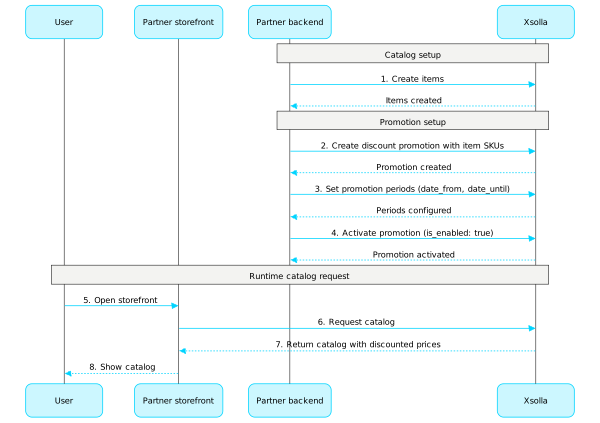
Refer to our documentation for detailed information about configuring promotions:
Coupons
Call API methods from this subsection to configure and manage coupon promotions.
Note
Refer to our documentation for detailed information about coupons.
Operations
Promo codes
Call API methods from this subsection to configure and manage promo code promotions.
Note
Refer to our documentation for detailed information about promo codes.
Operations
Unique catalog offers
Call API methods from this subsection to configure and manage unique catalog offers.
Note
Refer to our documentation for detailed information about unique offers.
Operations
Discounts
Call API methods from this subsection to configure and manage discount promotions.
Note
Refer to our documentation for detailed information about discounts.
Operations
Bonuses
Call API methods from this subsection to configure and manage bonus promotions.
Note
Refer to our documentation for detailed information about bonuses.
Operations
Personalized catalog
Personalization allows you to specify the conditions for displaying the item catalog and applying promotions only for specific authorized users. Conditions are defined based on user attributes and allow you to offer items and promotions that are most relevant to particular users.
The following personalization types are available:
- Xsolla-side personalization. Personalization rules and logic are configured and stored on the Xsolla side. You pass user attributes, and Xsolla uses them to generate a personalized catalog.
- Partner-side personalization. You configure personalization rules and logic on your side and send a final catalog payload for a specific user to Xsolla.
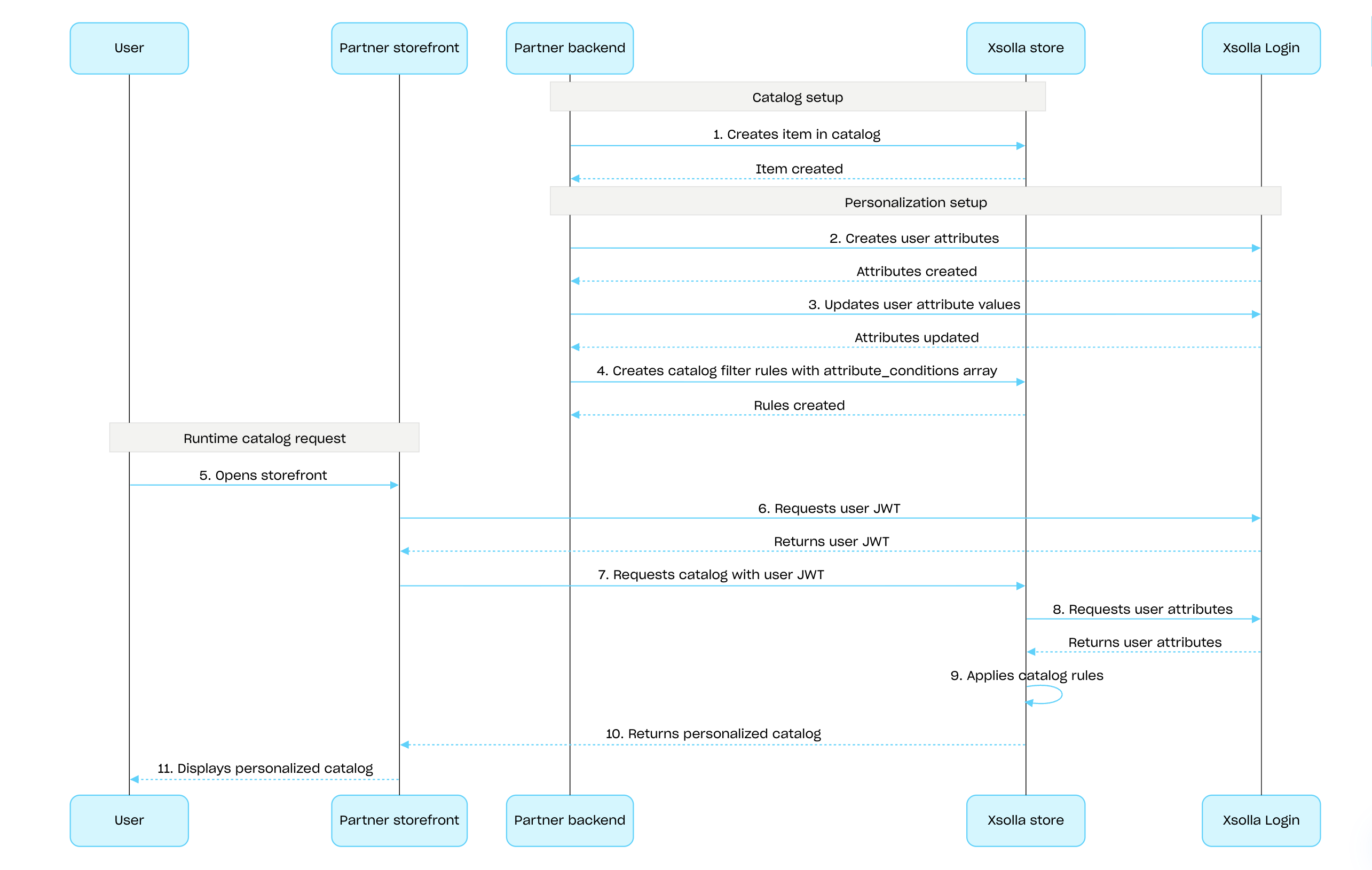
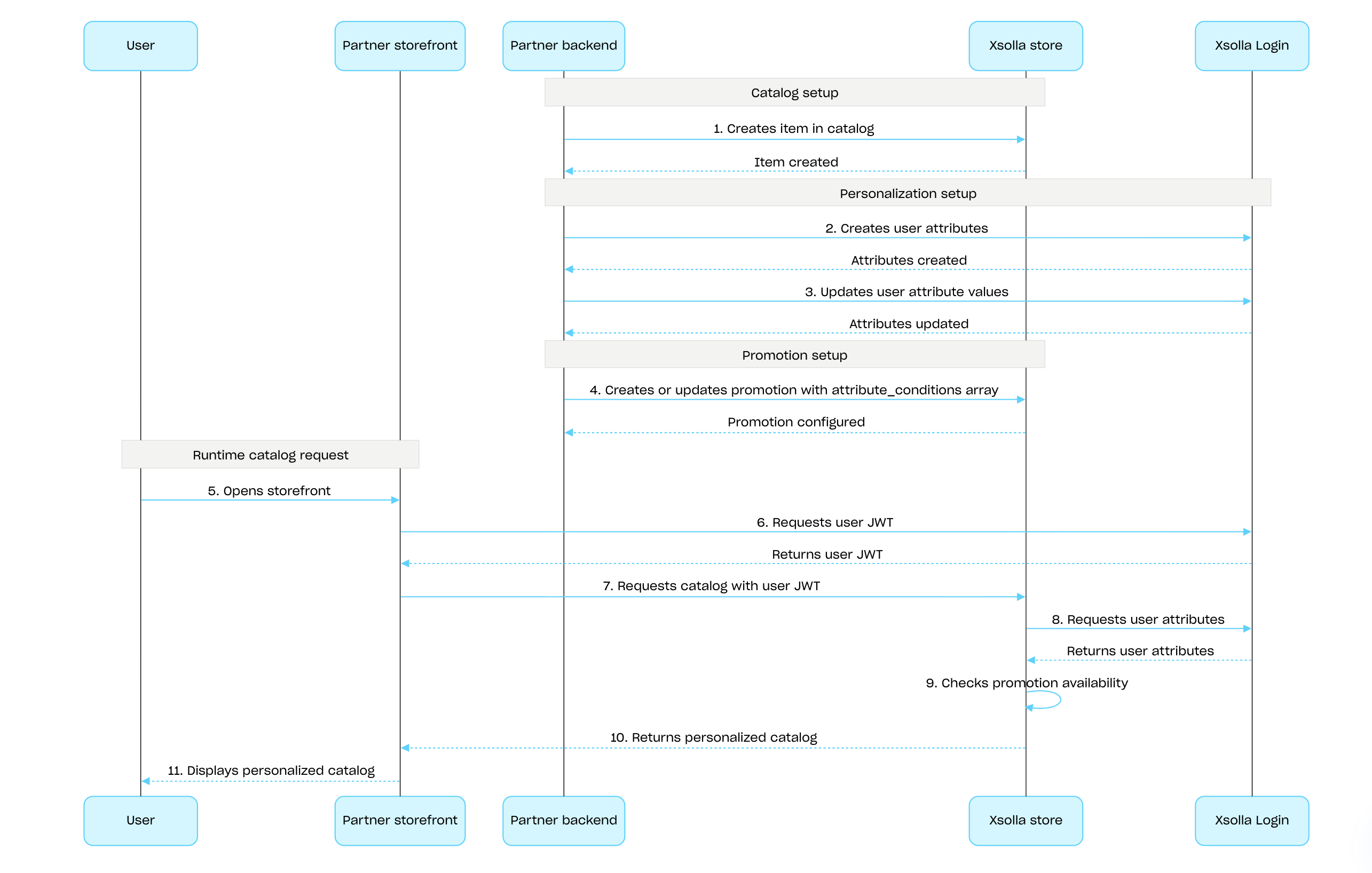
To configure personalization on the Xsolla side using the Xsolla API:
Create items using the API calls from the Admin subsection of the Virtual items and currency, Bundles or Game keys groups.
Set up user attributes using the Xsolla Login API and keep them synchronized by updating data in Xsolla whenever changes occur in your game.
Configure personalization for items or promotions:
- To personalize the item catalog, define catalog display rules using the Create catalog filter rule API call:
- In the attribute_conditions array, specify the conditions that determine item availability based on user attributes.
- In the items array, provide the list of items that should be visible to the user if their attributes match the specified conditions.
- To configure personalized promotions, use the create and update API calls for the required promotion type. In the attribute_conditions array, specify the conditions that determine promotion availability based on user attributes.
- To personalize the item catalog, define catalog display rules using the Create catalog filter rule API call:
Pass the user JWT with user attributes to the catalog retrieval API calls to receive a personalized catalog.
Sequence for configuring and applying Xsolla-side personalization for item catalog:
Sequence for configuring and applying Xsolla-side personalization for promotions:
Note
Detailed information is provided:
Detailed information is provided:
- in the guide to configuring personalization on the Xsolla side and the partner side
- in the step-by-step tutorial on item catalog personalization on the Xsolla side
Operations
Overview
Promotion usage limits allow you to restrict the number of times a specific user can use a promotion. You can also configure scheduled limit resets.
Limits are stored on the Xsolla side and are configured in the promotion settings in Publisher Account or via the limits object in the following API calls:
- Create discount promotion for item or Update discount promotion
- Create bonus promotion or Update bonus promotion
Limit information is returned in the items.promotions.limits object in the following API calls for retrieving the items catalog:
- Get virtual items list
- Get virtual currency list
- Get virtual currency packages list
- Get bundles list
- Get games list
The API calls in the Management subsection of the Limits group allow you to retrieve the current state of limits and update them for a specific user — for example, reset the counter after a quest is completed or manually adjust the remaining quantity.
Note
For detailed information on configuring limits in the catalog, refer to the Promotion usage limits section.
For detailed information on configuring limits in the catalog, refer to the Promotion usage limits section.
You can configure limits.per_user — a limit on the number of times a promotion can be used by a single user.
Unauthenticated users always see the maximum number of promotion uses.
To show the user's remaining promotion uses with the active limit applied, pass user authorization data when requesting the items catalog.
To configure a scheduled reset period — daily, weekly, or monthly — pass the limits.recurrent_schedule object when creating or updating a promotion.
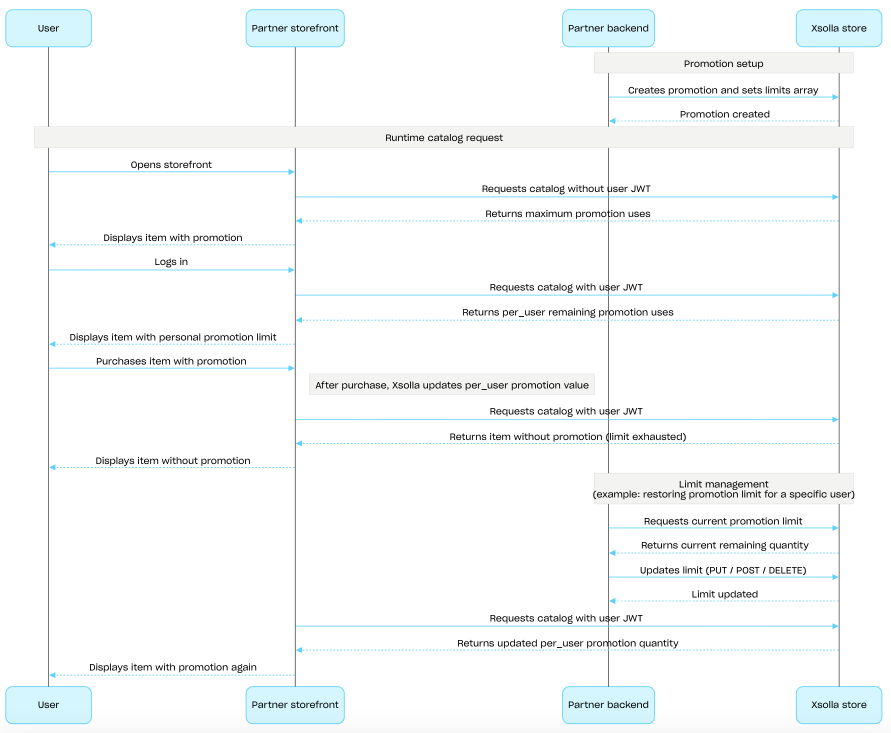
Limit configuration and enforcement scenario
- You create a promotion using the Create discount promotion for item or Create bonus promotion API call and pass the
limitsobject. - You request the catalog for an unauthenticated user — the response returns the maximum number of promotion uses in the
items.promotions.limitsobject. - The user logs in.
- You request the catalog with the user's authorization token — the response returns the remaining number of uses with the active limit applied.
- The user selects a promotional item and makes a purchase.
- After successful payment, Xsolla updates the
items.promotions.limits.per_uservalue. When it reaches0, the item is returned in the catalog API calls without a discount or bonus. - You can update the limit using the API calls from the Management subsection:
- You retrieve the updated limit value in
items.promotions.limitson the next catalog request made with the user's authorization token and display it to the user.
Overview
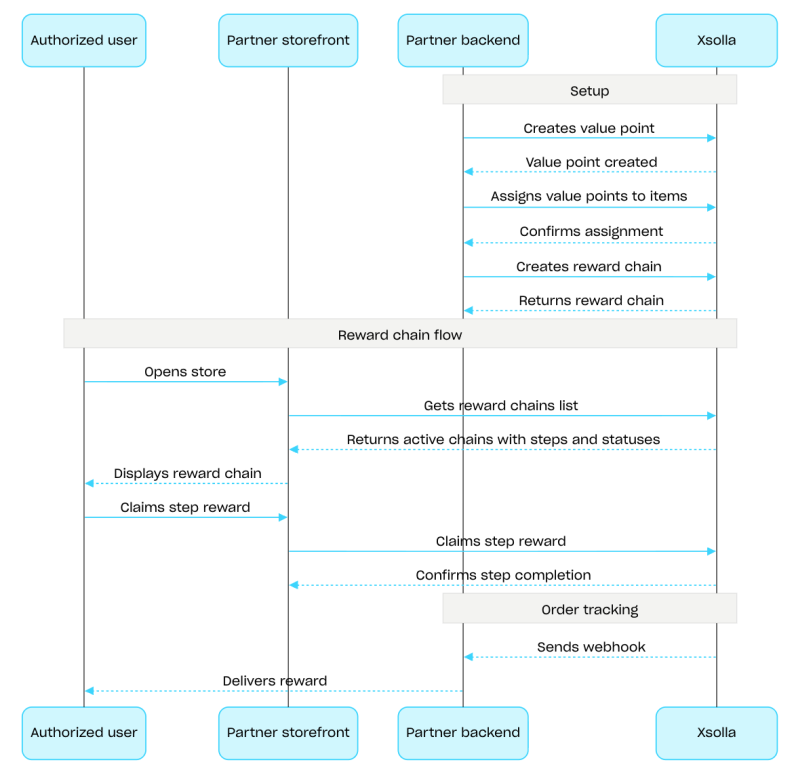
Reward chains encourage users to make purchases in the store using real currency. For each purchase, users earn value points and progress through a reward chain. If users are part of clans, their purchases contribute value points to the entire clan. For detailed information on configuring the reward chains, refer to the Reward system section.
To configure reward chains, use API calls from the Admin subsection. To display chains and claim rewards, use API calls from the Client subsection. To work with clan reward chains, use API calls from the Clans client subsection.
Example of reward chain configuration flow:
- Create items using the API calls from the Admin subsection of the Virtual items and currency or Bundles groups.
- Create value points using the Create value point API call.
- Assign value points to items using the Set value points for items API call. Users receive value points after purchasing these items.
- Create a chain using the Create reward chain API call. To activate the chain, pass the
is_enabled: trueparameter. - Implement reward chain display. To do this, request the list of available chains using the Get current user's reward chains API call. The response contains all active chains with their steps and statuses.
- Implement value point balance display. To do this, use the Get current user's value point balance API call.
- Implement step reward claiming. To do this, use the Claim step reward API call.
- Configure order status tracking, e.g., using webhooks, to promptly receive data on claimed rewards and grant them to the user.
Path
Project ID. You can find this parameter in your Publisher Account next to the project name and in the browser address bar when working with a project. The URL has the following format: https://publisher.xsolla.com/<merchant_id>/projects/<project_id>.
Example: 44056
- https://store.xsolla.com/api/v2/project/{project_id}/admin/items/{value_point_sku}/value_points/rewards
- Mock serverhttps://xsolla.redocly.app/_mock/api/liveops/v2/project/{project_id}/admin/items/{value_point_sku}/value_points/rewards
- curl
- JavaScript
- Node.js
- Python
- Java
- C#
- PHP
- Go
- Ruby
- R
- Payload
curl -i -X DELETE \
  -u <username>:<password> \
https://store.xsolla.com/api/v2/project/44056/admin/items/value_point_3/value_points/rewardsPath
Project ID. You can find this parameter in your Publisher Account next to the project name and in the browser address bar when working with a project. The URL has the following format: https://publisher.xsolla.com/<merchant_id>/projects/<project_id>.
Example: 44056
- https://store.xsolla.com/api/v3/project/{project_id}/admin/reward_chain
- Mock serverhttps://xsolla.redocly.app/_mock/api/liveops/v3/project/{project_id}/admin/reward_chain
- curl
- JavaScript
- Node.js
- Python
- Java
- C#
- PHP
- Go
- Ruby
- R
- Payload
curl -i -X GET \
  -u <username>:<password> \
'https://store.xsolla.com/api/v3/project/44056/admin/reward_chain?limit=50&offset=0&enabled=0'The list of reward chains was successfully received.
One of:
A reward chain.
Object with localizations for item’s name. Accepts value in one of two formats: two-letter lowercase language codes (e.g., en) or five-character language codes (e.g., en-US). While both formats are accepted as input, responses return two-letter lowercase language codes. When both options for the same language are provided (e.g., en and en-US), the last provided value is stored. You can find the full list of supported languages in the documentation.
Any of:
Two-letter lowercase language codes.
Object with localizations for item’s description. Accepts value in one of two formats: two-letter lowercase language codes (e.g., en) or five-character locale codes (e.g., en-US). While both formats are accepted as input, responses return two-letter lowercase language codes. When both options for the same language are provided (e.g., en and en-US), the last provided value is stored. You can find the full list of supported languages in the documentation.
Any of:
Two-letter lowercase language codes.
Object with localizations for long description of item. Accepts value in one of two formats: two-letter lowercase language codes (e.g., en) or five-character locale codes (e.g., en-US). While both formats are accepted as input, responses return two-letter lowercase language codes. When both variants for the same language are provided (e.g., en and en-US), the last provided value is stored. You can find the full list of supported languages in the documentation.
Any of:
Two-letter lowercase language codes.
Reward chain validity periods. If multiple periods are specified, both date_from and date_until are required.
Start date for the specified reward chain.
Example: "2020-08-11T10:00:00+03:00"
Item's additional assets such as screenshots, gameplay video and so on.
One of:
Recurrent reset period of the reward chain.
Frequency of the recurrent reset of the reward chain.
Value"weekly"
Day of the week when the reward chain is reset, where 1 is Monday and 7 is Sunday.
Time when the reward chain is reset in the desired time zone (rounding to hours).
For example, the set time for the reward chain reset is 01:00 for the Kuala Lumpur time zone (GMT+8). In this case, the value of the time parameter is 01:00:00+08:00.
Calculated date and time when the reward chain will be reset next time (Unix Timestamp).
For example, the reward chain is reset monthly, starting from March 1, 2024, at 01:00 Kuala Lumpur time (GMT+8). The date and time of the next reward chain reset, April 1, 2024 at 01:00 Kuala Lumpur time (GMT+8), which equals March 31, 2024 17:00 GMT+0 or 1711904400000 in the Unix Timestamp format.
Example: 1711904400000
Date and time of the first reset of the reward chain.
For example, the date and time of the first reset of the reward chain is March 1, 2024, at 01:00 Kuala Lumpur time, or 2024-03-01T01:00:00+08:00 in the ISO 8601 format.
Example: 2024-03-01T01:00:00+08:00
Calculated date and time when the reward chain will be reset next time (ISO 8601).
For example, the reward chain is reset monthly, starting from March 1, 2024, at 01:00 Kuala Lumpur time. The date and time of the next reward chain reset: April 1, 2024 at 01:00 Kuala Lumpur time, which equals 2024-04-01T01:00:00+08:00 in the ISO 8601 format.
Example: 2024-04-01T01:00:00+08:00
Conditions for validating user attributes. Determine chain availability based on whether user attributes match all specified conditions.
One of:
User attribute code.
Type of operation performed by condition. For string attribute type.
Possible values:
eq— Equalsne— Not equals
Enum"eq""ne"
Condition value which user attribute value will be compared to. Type depends on attribute type.
Indicates that the condition is met even if attribute is missing from user attributes. Pass true to show the item to users who don't have this attribute. Users who have the attribute, but the value does not match that specified in the condition, will not see the item. false — users who have the attribute, but the value does not match that specified in the condition, or the attribute is missing, will not see the item.
Whether the chain is visible to all users. If true, the chain is always displayed, regardless of the user's authentication status or attributes.
To configure personalization, you need to pass false. The logic of the chain display will be the following:
- If
falseis passed and the visibility conditions are specified in theattribute_conditionsarray, the chain is considered personalized and is displayed only to authorized users who meet the specified conditions. - If
falseis passed and theattribute_conditionsarray isn’t passed or is empty, the chain is displayed to unauthorized users, as well as in cases when no matching chain is found for the authorized user.
Whether to reset the reward chain (value points and progress of all users) after its end date:
- If
true, the reward chain will be reset after its end date. - If
false, the reward chain will not be reset after its end date.
Notice
Can’t be
Can’t be
true if: - A reset period is set in
recurrent_schedule. - The
nullvalue is passed inperiods.date_until.
Response
application/json
{
  "has_more": true,
  "items": [
    { … },
    { … }
  ]
}
Path
Bodyapplication/jsonProject ID. You can find this parameter in your Publisher Account next to the project name and in the browser address bar when working with a project. The URL has the following format: https://publisher.xsolla.com/<merchant_id>/projects/<project_id>.
Example: 44056
One of:
A reward chain.
Object with localizations for item’s name. Accepts value in one of two formats: two-letter lowercase language codes (e.g., en) or five-character language codes (e.g., en-US). While both formats are accepted as input, responses return two-letter lowercase language codes. When both options for the same language are provided (e.g., en and en-US), the last provided value is stored. You can find the full list of supported languages in the documentation.
Any of:
Two-letter lowercase language codes.
Object with localizations for item’s description. Accepts value in one of two formats: two-letter lowercase language codes (e.g., en) or five-character locale codes (e.g., en-US). While both formats are accepted as input, responses return two-letter lowercase language codes. When both options for the same language are provided (e.g., en and en-US), the last provided value is stored. You can find the full list of supported languages in the documentation.
Any of:
Two-letter lowercase language codes.
Object with localizations for long description of item. Accepts value in one of two formats: two-letter lowercase language codes (e.g., en) or five-character locale codes (e.g., en-US). While both formats are accepted as input, responses return two-letter lowercase language codes. When both variants for the same language are provided (e.g., en and en-US), the last provided value is stored. You can find the full list of supported languages in the documentation.
Any of:
Two-letter lowercase language codes.
Reward chain validity periods. If multiple periods are specified, both date_from and date_until are required.
Start date for the specified reward chain.
Example: "2020-08-11T10:00:00+03:00"
Object with localizations for item’s name. Accepts value in one of two formats: two-letter lowercase language codes (e.g., en) or five-character language codes (e.g., en-US). While both formats are accepted as input, responses return two-letter lowercase language codes. When both options for the same language are provided (e.g., en and en-US), the last provided value is stored. You can find the full list of supported languages in the documentation.
Any of:
Two-letter lowercase language codes.
Unique item ID. The SKU may contain only lowercase and uppercase Latin alphanumeric characters, periods, dashes, and underscores.
Conditions for validating user attributes. Determine reward availability for reward chain steps based on whether user attributes match all specified conditions.
One of:
steps[].reward[].attribute_conditions[].attributestring[ 1 .. 255 ] characters^[-_.\d\w]+$required
User attribute code.
Type of operation performed by condition. For string attribute type.
Possible values:
eq— Equalsne— Not equals
Enum"eq""ne"
Condition value which user attribute value will be compared to. Type depends on attribute type.
Indicates that the condition is met even if attribute is missing from user attributes. Pass true to show the item to users who don't have this attribute. Users who have the attribute, but the value does not match that specified in the condition, will not see the item. false — users who have the attribute, but the value does not match that specified in the condition, or the attribute is missing, will not see the item.
One of:
Recurrent reset period of the reward chain.
Frequency of the recurrent reset of the reward chain.
Value"weekly"
Day of the week when the reward chain is reset, where 1 is Monday and 7 is Sunday.
Time when the reward chain is reset in the desired time zone (rounding to hours).
For example, the set time for the reward chain reset is 01:00 for the Kuala Lumpur time zone (GMT+8). In this case, the value of the time parameter is 01:00:00+08:00.
Conditions for validating user attributes. Determine chain availability based on whether user attributes match all specified conditions.
One of:
User attribute code.
Type of operation performed by condition. For string attribute type.
Possible values:
eq— Equalsne— Not equals
Enum"eq""ne"
Condition value which user attribute value will be compared to. Type depends on attribute type.
Indicates that the condition is met even if attribute is missing from user attributes. Pass true to show the item to users who don't have this attribute. Users who have the attribute, but the value does not match that specified in the condition, will not see the item. false — users who have the attribute, but the value does not match that specified in the condition, or the attribute is missing, will not see the item.
Whether the chain is visible to all users. If true, the chain is always displayed, regardless of the user's authentication status or attributes.
To configure personalization, you need to pass false. The logic of the chain display will be the following:
- If
falseis passed and the visibility conditions are specified in theattribute_conditionsarray, the chain is considered personalized and is displayed only to authorized users who meet the specified conditions. - If
falseis passed and theattribute_conditionsarray isn’t passed or is empty, the chain is displayed to unauthorized users, as well as in cases when no matching chain is found for the authorized user.
Whether to reset the reward chain (value points and progress of all users) after its end date:
- If
true, the reward chain will be reset after its end date. - If
false, the reward chain will not be reset after its end date.
Notice
Can’t be
Can’t be
true if: - A reset period is set in
recurrent_schedule. - The
nullvalue is passed inperiods.date_until.
- https://store.xsolla.com/api/v3/project/{project_id}/admin/reward_chain
- Mock serverhttps://xsolla.redocly.app/_mock/api/liveops/v3/project/{project_id}/admin/reward_chain
- curl
- JavaScript
- Node.js
- Python
- Java
- C#
- PHP
- Go
- Ruby
- R
- Payload
curl -i -X POST \
  -u <username>:<password> \
  https://store.xsolla.com/api/v3/project/44056/admin/reward_chain \
  -H 'Content-Type: application/json' \
  -d '{
    "name": {
      "en": "Reward chain"
    },
    "description": {
      "en": "Reward chain description."
    },
    "long_description": {
      "en": "Reward chain long description."
    },
    "is_enabled": true,
    "image_url": "https://cdn.xsolla.net/img/misc/images/5c3b8b45c5be5fe7803e59fbc8041be4.png",
    "order": 1,
    "periods": [
      {
        "date_from": "2026-01-01T01:00:00+05:00",
        "date_until": "2026-01-31T23:59:59+05:00"
      },
      {
        "date_from": "2026-02-01T01:00:00+05:00",
        "date_until": "2026-02-28T23:59:59+05:00"
      }
    ],
    "value_point": {
      "sku": "com.xsolla.value_point_1"
    },
    "steps": [
      {
        "name": {
          "en": "First step of the reward chain"
        },
        "image_url": "https://cdn.xsolla.net/img/misc/images/5c3b8b45c5be5fe7803e59fbc8041be4.png",
        "reward": [
          {
            "sku": "com.xsolla.item_1",
            "quantity": 5
          },
          {
            "sku": "com.xsolla.item_2",
            "quantity": 1
          }
        ],
        "price": {
          "amount": 10
        }
      },
      {
        "name": {
          "en": "Second step of the reward chain"
        },
        "image_url": "https://cdn.xsolla.net/img/misc/images/5c3b8b45c5be5fe7803e59fbc8041be4.png",
        "reward": [
          {
            "sku": "com.xsolla.item_3",
            "quantity": 5
          },
          {
            "sku": "com.xsolla.item_4",
            "quantity": 1
          }
        ],
        "price": {
          "amount": 15
        }
      }
    ],
    "recurrent_schedule": {
      "interval_type": "weekly",
      "day_of_week": 1,
      "time": "01:00:00+08:00"
    },
    "attribute_conditions": [
      {
        "attribute": "race",
        "operator": "eq",
        "value": "ork",
        "type": "string",
        "can_be_missing": false
      }
    ],
    "is_always_visible": true,
    "is_reset_after_end": true
}'Response
application/json
{
  "reward_chain_id": 10
}
Overview
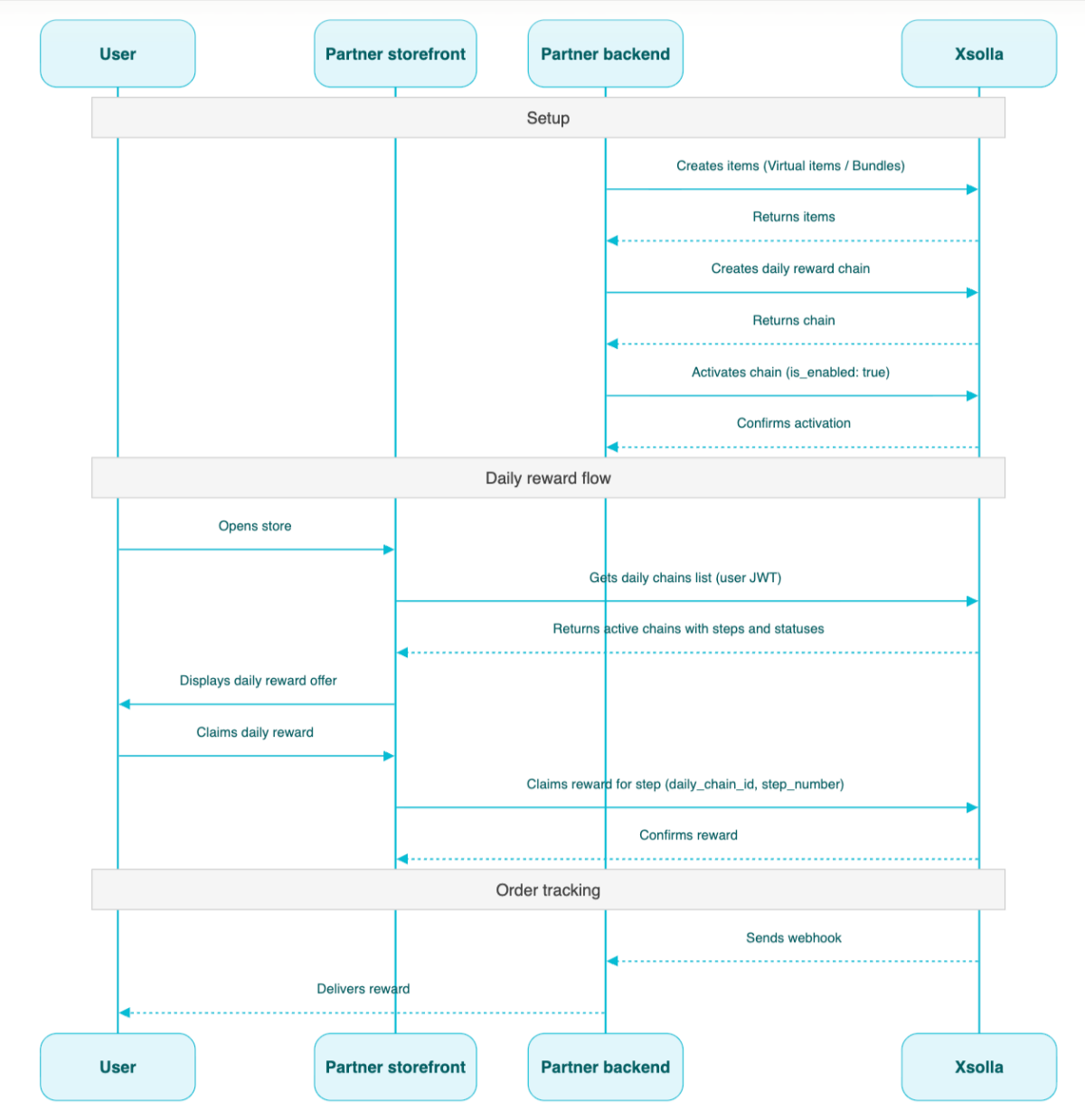
Daily rewards motivate users to log into the store every day to receive free items. The behavior when a day is skipped depends on the chain type. For daily rewards to work correctly, you need to configure user authentication. Unauthenticated users can see the full daily reward chain but cannot claim rewards. For detailed information on configuring daily rewards, refer to the Daily rewards section.
Chains are configured using the API calls from the Admin subsection. To grant rewards, use the API calls from the Client subsection.
Daily chain configuration scenario:
- Create items using the API calls from the Admin subsection of the Virtual items and currency or Bundles groups.
- Create a chain using the Create daily reward API call.
- Activate the chain by passing the
"is_enabled": trueparameter to the Create daily reward API call. - Request the list of available chains using the Get current user's daily rewards API call, passing the user JWT. The response contains all active chains with their steps and statuses.
- Set up item granting via webhooks.
- Grant the user their daily reward using the Claim daily reward step API call, passing
daily_chain_idandstep_number.
Overview
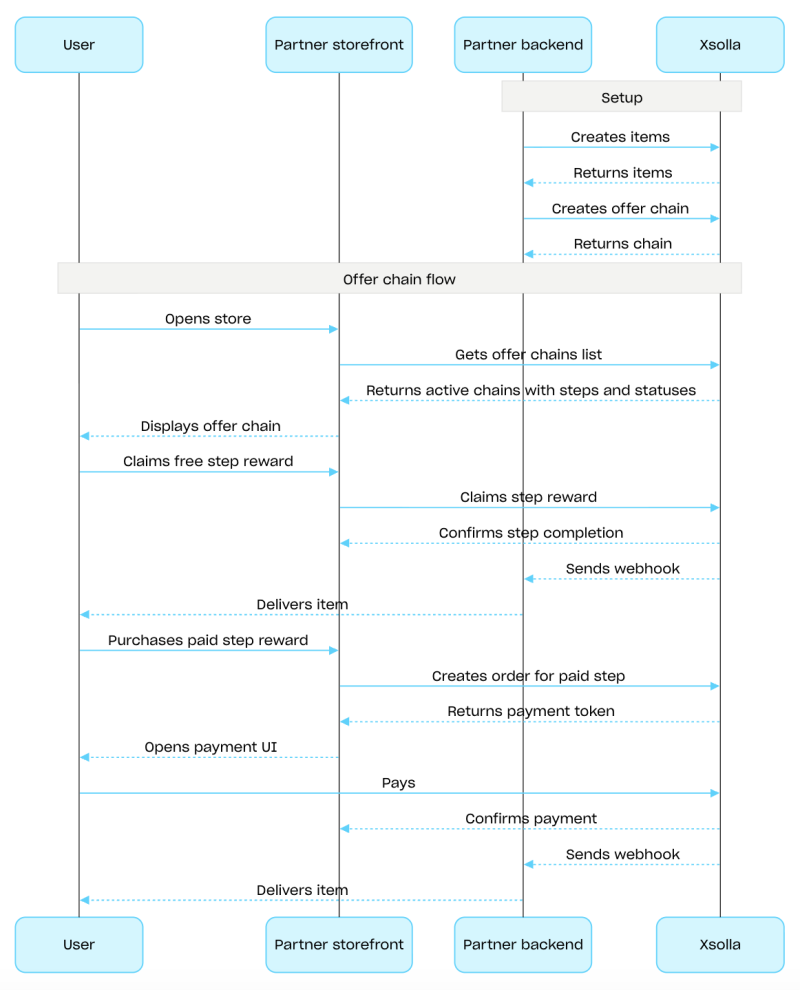
Offer chains are a sequence of steps, each containing an item that users receive for free or purchase as part of an active offer. Offer chains can include exclusive items available only within the chain, as well as items at discounted prices compared to store prices. For detailed information on configuring this marketing tool, refer to the Offer chains section.
To configure offer chains, use API calls from the Admin subsection. To display chains and implement the logic for working with items that users receive, use API calls from the Client subsection.
Example of offer chain configuration flow:
Create items using the API calls from the Admin subsection of the Virtual items and currency or Bundles groups.
Create a chain using the Create offer chain API call. To activate the chain, pass the
is_enabled: trueparameter.Implement offer chain display. To do this, request the list of available chains using the Get current user's offer chains API call. The response contains all active chains with their steps and statuses.
Implement the logic for working with items that users receive:
If the step item is free, use the Claim free offer chain step API call. Pass
offer_chain_idandstep_numberin the request.If the step item is paid, use the Create order for paid offer chain step API call. Pass
offer_chain_idandstep_numberin the request. The response returns anorder_idand token to open the payment UI.
Configure order status tracking, e.g., using webhooks, to promptly receive data on claimed or purchased items and grant them to the user.
Overview
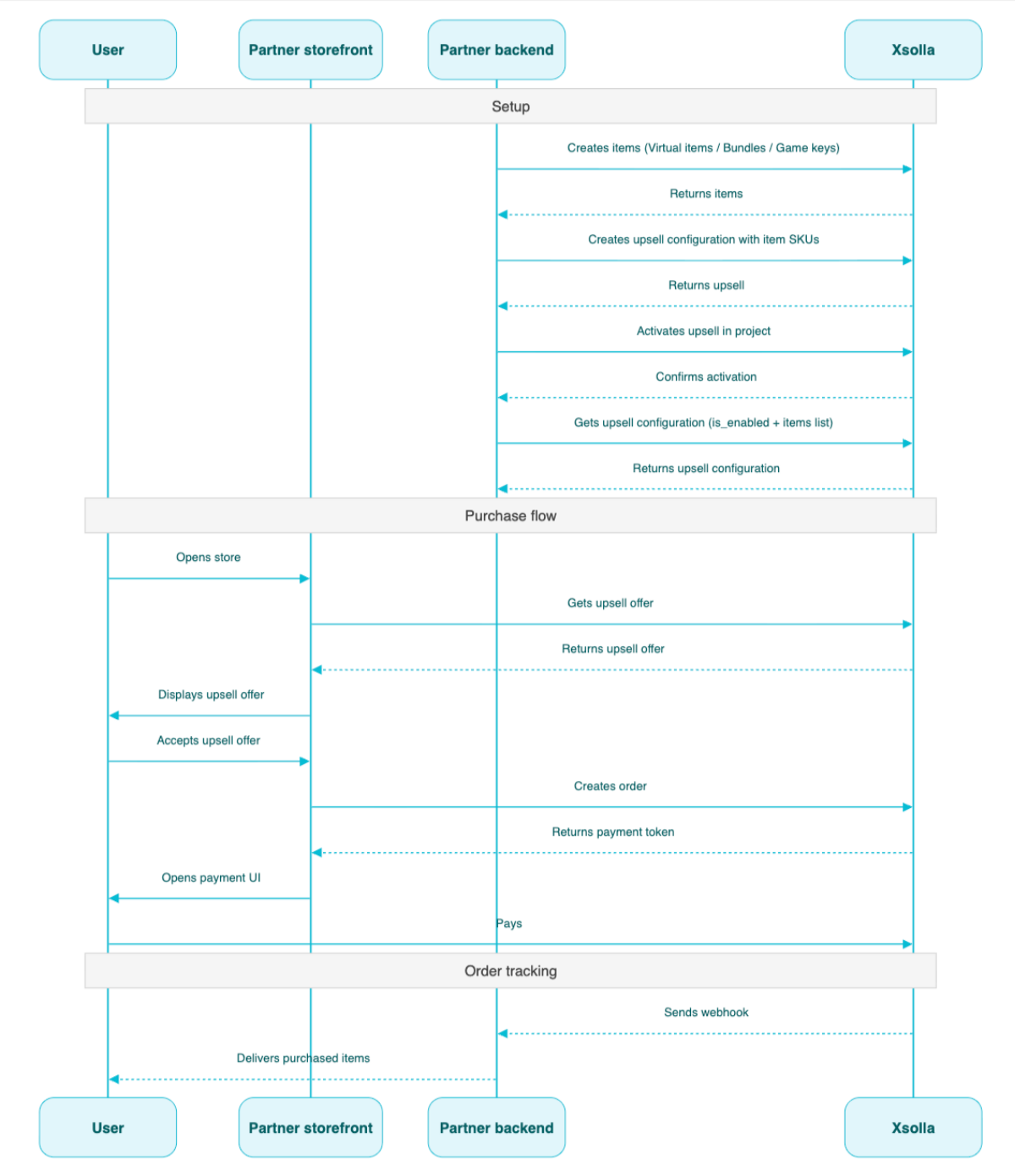
Upsell is a sales method in which the user is offered to buy an item with additional value. For example, this could be the item that is in the greatest demand among other users. You can also configure regional restrictions for upsell items. For detailed information, refer to the Upsell section.
The list of items configured for upsell and the upsell status (enabled or disabled) are returned by the Get information about upsell in project API method. On the client side, the list of items is returned by the Get list of upsell items in project API method and displayed to the user at the appropriate point in the purchase flow.
Upsell configuration scenario:
- Create items using the API calls from the Admin subsection of the Virtual items and currency, Bundles, or Game keys groups.
- Set up the upsell using the Create upsell API call. Pass the SKUs of the required items in the
itemsarray. - Activate upsell for the project using the Activate/Deactivate project's upsell API call.
- Display the upsell offer to the user at the appropriate point in the purchase flow using the Get list of upsell items in project API call.
- Implement the opening of the payment UI to pay for the order. For example, you can use the Create order with all items from particular cart API call. The response returns a token to open the payment UI.
- Configure order status tracking, e.g., using webhooks, to promptly receive data about successfully paid items and grant them to the user.
Overview
The Loyalty as Service API allows you to manage users' loyalty point balances: get a user's current balance, as well as credit and debit loyalty points.
The Admin API calls of the Loyalty as Service API are server-side and require basic authentication.
The base URL for this API is https://loyalty-points.xsolla.com/.
For detailed information on how to set up this marketing tool, see Loyalty as Service.